


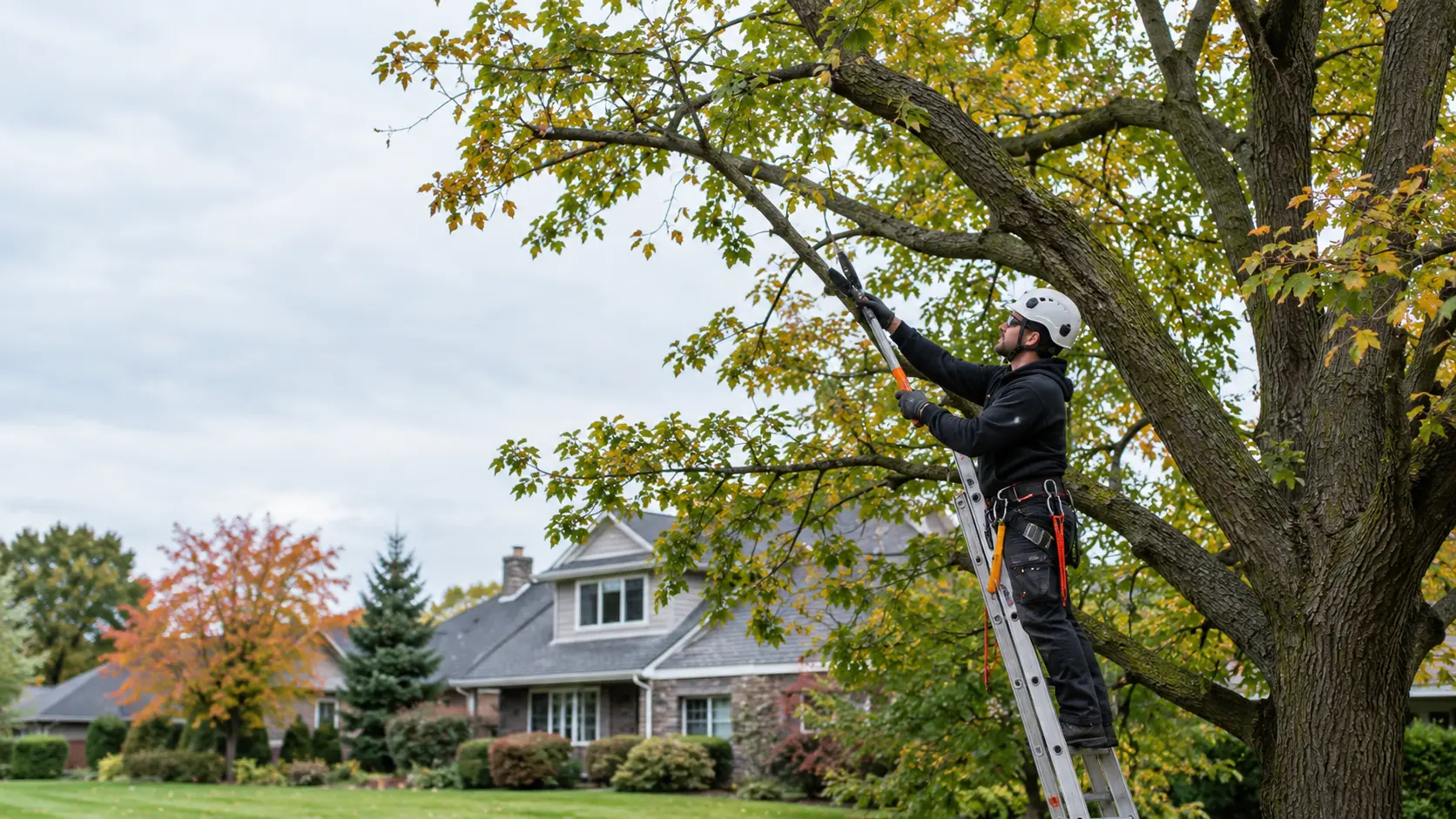
If you’ve ever called a tree company and asked about trimming a tree, you may have heard someone refer to it as pruning instead. It can be confusing because people often use the two words interchangeably.
They are related, but they aren’t always talking about exactly the same thing.
In simple terms, pruning is usually about the health and structure of the tree, while trimming is often more concerned with controlling growth and keeping branches where they belong. In real-world tree care, though, the two can overlap quite a bit.
For homeowners looking for tree pruning in Buffalo NY services, understanding the difference can make it easier to figure out what your trees actually need.
So, What Is Tree Pruning?
Think of pruning as making careful decisions about which branches should stay and which should go.
A tree may have a dead branch that no longer contributes anything to the canopy. It may have two branches rubbing against each other, a weak branch growing at an awkward angle, or a damaged limb that could become a problem later.
Those are situations where pruning can make sense.
The goal isn’t to make the tree look perfectly shaped. A healthy tree doesn’t necessarily have a perfectly symmetrical canopy. Instead, good pruning works with the tree’s natural structure.
Pruning may be used to:
- Remove dead or broken branches
- Improve the structure of a young tree
- Remove branches that are rubbing together
- Reduce the chance of certain branch failures
- Remove damaged or diseased growth
- Improve the overall condition of the canopy
- Correct structural problems before they become larger issues
This is why pruning is often considered part of long-term tree care rather than simply a way to make a tree look neater.
Then What Does Tree Trimming Mean?
Trimming is a little harder to define because the word is used so broadly.
A homeowner might say they need a tree trimmed because branches have grown over a driveway. Someone else might use the same word when they want branches cleared away from a roof or window.
In those situations, the main concern may not be the health of the tree. It may simply be that the branches have grown into an inconvenient place.
For example, imagine a tree beside your driveway. Over several years, its branches extend farther and farther toward the area where you park your vehicle. Selective cutting can provide the clearance you need without dramatically changing the tree.
That’s a very different situation from removing a dead limb from the middle of the canopy.
Both might be casually described as “trimming,” even though the reasons for doing the work are different.
Why the Difference Actually Matters
You might be wondering: does it really matter whether you call it pruning or trimming?
Not necessarily when you’re talking to a tree company. A good tree-care professional will usually want to look at the tree and understand the problem rather than rely on the word you use.
What matters is why the branches need to be removed and how much should actually be removed.
That’s important because cutting branches isn’t automatically good for a tree.
A tree that has become too large for a particular space may need some selective work. But removing large amounts of healthy growth simply because the canopy looks too full can create new problems.
Good tree work is usually more about making the right cuts than making a lot of cuts.
Buffalo Weather Can Change the Situation
Trees in Buffalo have to deal with some pretty demanding weather.
Heavy snow, ice, strong winds, summer storms, and sudden temperature changes can all put stress on branches. A limb that was perfectly fine a few months ago may become cracked or weakened after a severe storm.
That’s one reason it’s worth paying attention to your trees after major weather events.
Look up into the canopy from a safe location and check for anything that looks different. Is a large branch hanging lower than it used to? Did a limb split? Are there branches resting against each other? Is something now leaning toward the house?
You don’t need to climb the tree to investigate.
If a large or damaged branch is hanging over a home, vehicle, driveway, or area where people walk, it’s better to have it assessed rather than trying to remove it yourself.
Young Trees Often Need a Different Kind of Attention
Pruning isn’t just something you do when a mature tree becomes a problem.
Young trees can benefit from thoughtful structural pruning as they develop. When a tree is small, it is sometimes easier to identify branches that may cause problems later.
For example, two major branches may be competing for the same space, or a branch may be developing with a weak attachment.
Addressing structural issues early can help the tree develop a stronger framework as it grows.
That doesn’t mean a newly planted tree should be heavily cut back. In fact, removing too much healthy growth can put unnecessary stress on a young tree.
The idea is to make a few well-considered cuts when they are actually needed.
What About Dead Branches?
Dead branches are one of the more obvious reasons to consider professional tree work.
They don’t heal or grow back, and eventually they may fall on their own. A small dead twig isn’t necessarily a major concern, but larger dead limbs deserve more attention, particularly when they are located above places where people, cars, or buildings are regularly present.
Storm-damaged branches can be even more complicated because a branch may remain attached while being partially split or under significant tension.
That’s a situation where grabbing a chainsaw isn’t a good idea.
A professional can assess how the branch is supported and determine the safest way to remove it.
Don’t Confuse Pruning With Cutting a Tree Down
This is another point worth clearing up.
Pruning or trimming does not necessarily mean removing a large portion of the tree.
In most cases, the purpose is to retain as much healthy structure as possible while dealing with specific problems.
Tree removal is an entirely different service. Removal may become necessary when a tree is dead, severely damaged, structurally unsafe, diseased beyond recovery, or simply located where it poses an unacceptable risk.
A tree shouldn’t be removed just because it needs pruning.
If you’re unsure whether a tree needs a few branches removed or needs more extensive work, an inspection can help answer that question.
How Much Is Too Much?
One of the easiest mistakes to make is assuming that a heavily cut tree is a well-maintained tree.
It isn’t.
Removing too much live growth at once can stress a tree. Severe cutting can also leave large wounds and dramatically change the way the tree grows.
You may have seen trees that have been cut back so severely that only short branch stubs remain. This type of aggressive cutting can lead to weak, fast-growing shoots and an unattractive structure.
Good pruning is usually much less dramatic.
When you look at a properly pruned tree, you may not even notice that much work was done. The tree should still look like a tree, not like it has been stripped down.
When Should You Call a Professional Tree Pruning in Buffalo NY?
There are some small branches that homeowners can safely deal with from the ground using appropriate hand tools.
The situation is different when branches are high, large, damaged, close to a structure, or anywhere near electrical lines.
A chainsaw becomes especially dangerous when you are working from a ladder or trying to control a heavy branch while cutting it.
If you’re dealing with a mature tree beside your house, a large storm-damaged limb, or branches growing into utility lines, professional help is the safer option.
A professional assessment can also prevent unnecessary cutting. Sometimes the best recommendation may be to leave a healthy branch alone.
Pruning and Trimming Can Work Together
The reality is that homeowners don’t always need to choose between “pruning” and “trimming.”
A single tree may need several types of work.
A tree beside a house, for example, might have a dead branch that should be removed for safety, a few branches that need clearance from the roof, and another branch that is developing poorly.
One visit could involve all three.
The important part is having someone look at the whole tree rather than treating every branch as a separate problem.
The Best Approach Is to Look at the Tree, Not Just the Name of the Service
Whether you call it trimming, pruning, branch removal, or simply tree maintenance, the goal should be the same: make sensible cuts that address an actual problem without unnecessarily damaging healthy growth.
Buffalo’s weather makes regular attention especially worthwhile. Trees can change significantly after a heavy snow, ice event, or strong windstorm, and small structural problems can become much more difficult to deal with as a tree gets larger.
If you’re unsure what your tree needs, Evergreen Tree Service can evaluate the tree and help determine whether selective pruning, trimming, storm-damage work, or another approach makes sense.
For professional tree care in Buffalo and surrounding Western New York communities, contact Evergreen Tree Service at (716) 451-3716.