


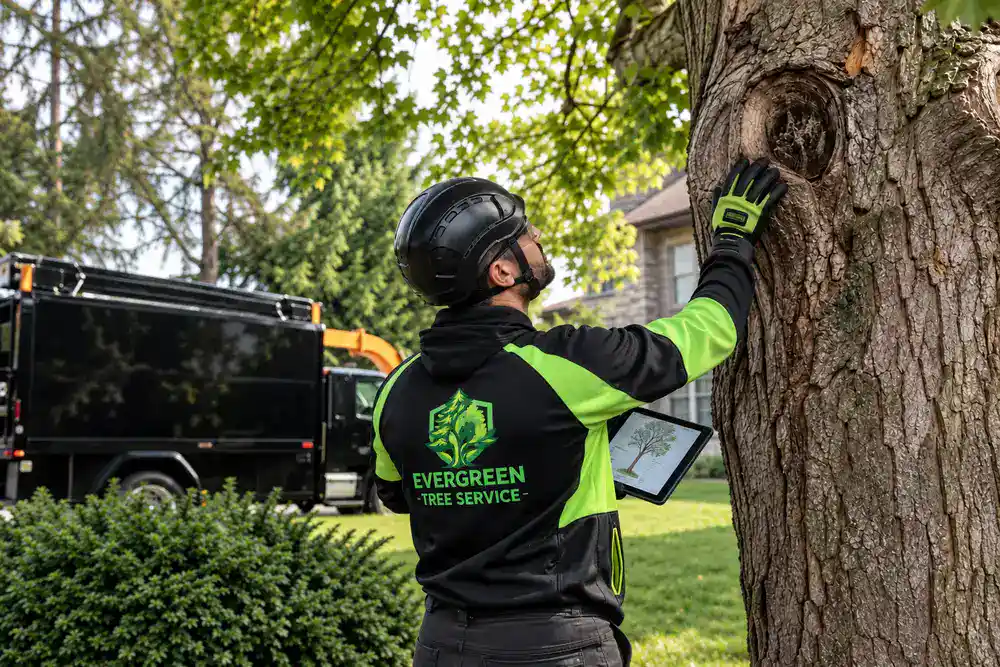
Trees add shade, beauty, and character to Buffalo properties, but there are situations when a tree becomes a safety concern rather than an asset. Knowing when to consider professional tree removal can help homeowners address potential hazards before they lead to property damage, blocked driveways, or personal injury.
Not every damaged or declining tree needs to be removed. However, when a tree has become structurally unstable, severely damaged, or is growing in an unsafe location, professional evaluation can help determine the right course of action.
If you are unsure about the condition of a tree on your property, here are several signs that it may be time to consider professional tree removal in Buffalo, NY.
1. The Tree Is Dead or Severely Declining
One of the clearest reasons to consider tree removal is when a tree has died or is experiencing significant decline.
Dead trees can lose branches unexpectedly, particularly during periods of strong wind, heavy snow, or severe weather. As decay progresses, the trunk and major limbs may become increasingly weak.
Some signs of a dead or seriously declining tree include:
- Little or no leaf growth during the growing season
- Extensive dead branches throughout the canopy
- Peeling or unusually loose bark
- Fungal growth around the trunk or roots
- Visible cavities or areas of decay
- Cracks in major limbs or the trunk
A tree that is declining gradually may not appear immediately dangerous. However, structural problems can become more significant over time.
2. Large Branches Are Dead, Broken, or Hanging
You do not necessarily need to remove an entire tree because it has a few damaged branches. In many cases, professional pruning can address isolated problems.
The situation becomes more concerning when large limbs are dead, split, hanging, or positioned over areas where people, vehicles, homes, or other structures are located.
Buffalo’s changing weather conditions can place additional stress on vulnerable branches. Strong winds and heavy winter snow can cause already-weakened limbs to break.
A professional tree assessment can help determine whether selective pruning is sufficient or whether the tree has larger structural problems that may require removal.
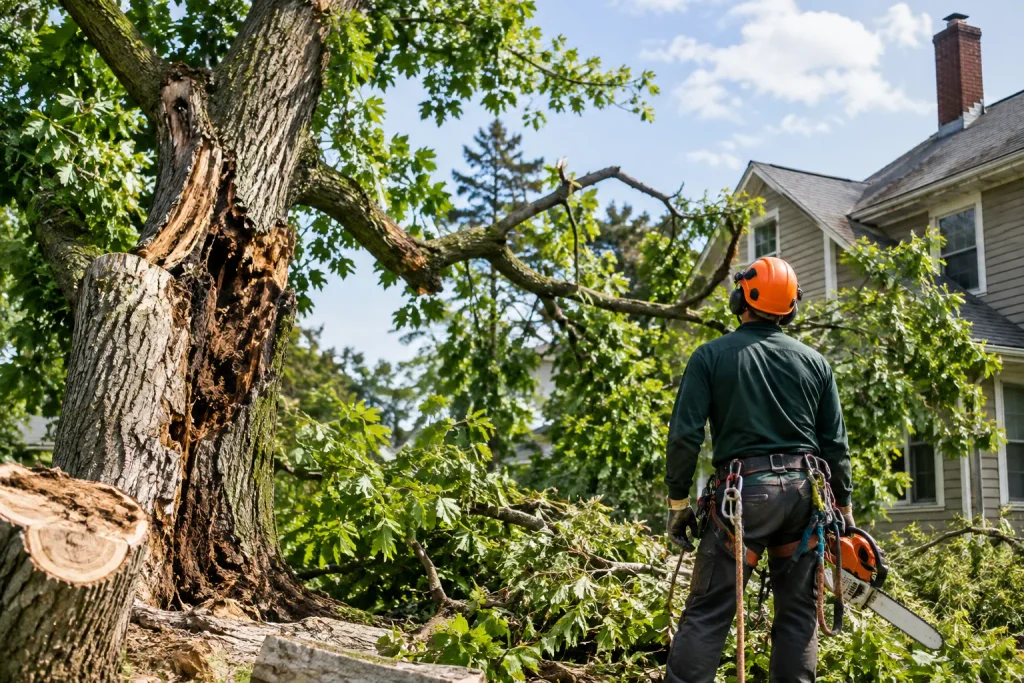
3. The Tree Has Significant Trunk Damage
The trunk is the main structural support of a tree. Serious cracks, cavities, decay, or other damage can compromise its stability.
Pay particular attention to:
- Deep cracks in the trunk
- Large cavities
- Splitting around major branch unions
- Extensive decay
- Significant areas of missing bark
- Leaning associated with root or trunk damage
A small surface imperfection does not automatically mean a tree must be removed. The location, size, depth, and overall condition of the damage all matter.
When trunk damage is substantial, having the tree evaluated by a qualified professional can help determine whether removal is appropriate.
4. The Tree Is Leaning in a Concerning Direction
Trees do not always grow perfectly straight. A natural lean that has remained stable for years may not necessarily indicate an immediate problem.
A newly developed or rapidly increasing lean deserves more attention.
This is especially important when the lean is accompanied by:
- Cracked or lifted soil around the roots
- Exposed roots
- Trunk cracks
- Broken branches
- Root damage
- Signs that the tree has shifted following a storm
A tree leaning toward a house, driveway, road, utility line, or frequently used area may present a greater potential hazard if its stability is compromised.
5. The Roots Are Damaged or Unstable
Tree problems are not always visible above ground.
Roots provide essential support, and significant root damage can affect a tree’s stability. Construction, excavation, severe weather, soil changes, disease, and physical damage can all contribute to root problems.
Warning signs can include exposed or damaged roots, soil lifting around the root plate, fungal growth near the base, or noticeable changes in the tree’s stability.
Because much of a tree’s root system is underground, determining the extent of root damage can be difficult from the surface. Professional evaluation can help identify whether the tree can remain safely in place.
6. The Tree Has Been Damaged by a Buffalo Storm
Severe weather can change the condition of a tree very quickly.
After strong winds, heavy snow, ice, or thunderstorms, inspect your property from a safe distance. Look for broken limbs, split trunks, fallen trees, hanging branches, and trees that have shifted or begun leaning.
A damaged tree does not always need to be removed. Some trees can be stabilized or restored through appropriate pruning and other tree-care measures.
However, trees with severe structural damage may need to be removed to reduce the risk of further damage.
If a tree has fallen or a large broken branch is creating an immediate hazard, avoid approaching unstable areas and keep people away until the situation can be safely assessed.
7. The Tree Is Growing Too Close to a Structure
Location can also be a reason to consider tree removal.
A tree growing close to a home is not automatically a problem. Healthy trees can often coexist safely with buildings when they are properly maintained.
However, removal may become a consideration when a tree has serious structural defects and is positioned where failure could damage:
- Roofs
- Garages
- Siding
- Fences
- Vehicles
- Driveways
- Other structures
In some situations, careful pruning can reduce the risk without removing the tree. The appropriate solution depends on the tree’s health, structure, location, and surrounding conditions.
8. The Tree Is Interfering With Utility Lines
Trees growing around overhead utility lines require particular caution.
Branches contacting or growing into utility lines can create dangerous conditions. Homeowners should never attempt to cut branches that are touching or dangerously close to electrical wires.
If a tree is interfering with utility infrastructure, contact the appropriate utility provider and a qualified tree professional for guidance.
Depending on the circumstances, the solution may involve pruning rather than complete removal.
9. The Tree Has Become a Recurring Problem
Sometimes a tree’s condition becomes an ongoing maintenance concern.
Repeatedly dropping large dead branches, developing new structural defects, suffering recurring storm damage, or showing progressive decline may indicate that the tree needs a more thorough evaluation.
Rather than addressing each problem individually, it can be useful to look at the overall condition of the tree.
The goal is not simply to remove trees. A professional assessment should consider whether the tree can remain healthy and reasonably safe with appropriate care or whether removal has become the more practical option.
Tree Removal Is Not Always the First Solution
One important point is that tree removal should not automatically be the answer to every tree problem.
Depending on the circumstances, alternatives may include:
- Crown cleaning
- Structural pruning
- Deadwood removal
- Crown reduction
- Cabling or other support measures where appropriate
- Monitoring the tree over time
The right approach depends on the tree’s species, age, health, structure, location, and surrounding environment.
A professional evaluation can help distinguish between a tree that needs maintenance and one that has reached the point where removal is warranted.
Why Professional Tree Removal Matters
Removing a large tree is very different from cutting down a small tree in an open area.
Trees can be heavy, unpredictable, and difficult to control once sections are cut. Their branches and trunks can also damage roofs, vehicles, landscaping, fences, and other property if they are not properly managed.
Professional tree removal involves evaluating the tree and surrounding area, determining how it can be safely dismantled, and using appropriate equipment and techniques to control the removal process.
For larger or hazardous trees, professional tree removal can help reduce unnecessary risks to people and property.
What to Do If You Are Unsure About a Tree
If you have noticed a significant crack, major dead branches, storm damage, decay, or a new lean, do not assume that the tree is safe simply because it has not fallen.
Start by keeping people and vehicles away from areas that could be affected if a branch or tree were to fail. Avoid climbing the tree or attempting to remove large branches yourself.
Then consider having the tree professionally evaluated.
For homeowners searching for tree removal Buffalo NY, Evergreen Tree Service provides professional tree care for residential and commercial properties in Buffalo and surrounding communities. Our tree removal services are designed to address hazardous, damaged, declining, or otherwise unwanted trees while taking care around the surrounding property.
Final Thoughts
A tree can remain an important part of your landscape for decades when it is healthy and properly maintained. But when serious structural problems, disease, decay, storm damage, or instability develop, leaving the tree unattended can create unnecessary risks.
The key is recognizing warning signs early.
If you are concerned about a tree on your Buffalo property, professional evaluation can help you understand whether it needs pruning, additional monitoring, or complete removal. Taking action before a tree becomes an emergency can also make the work safer and easier to manage.
Need professional tree removal in Buffalo, NY? Contact Evergreen Tree Service at (716) 451-3716 to discuss your tree-care needs and request an estimate.